
From hazelnut shell to plate: how Türkiye's largest agricultural waste becomes a product
Every year hundreds of thousands of tonnes of hazelnut shells are burned or discarded. The four-step story of how that shell returns to our tables as a plate.
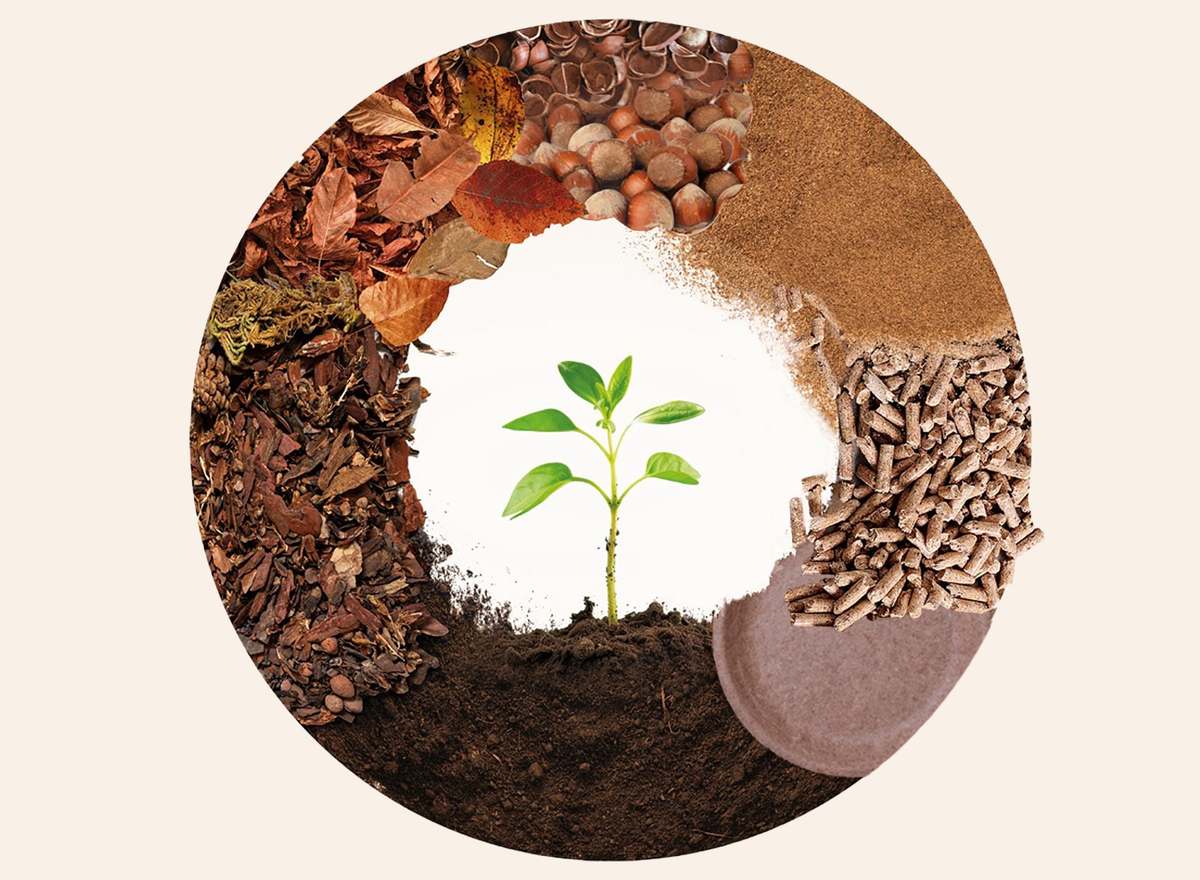
Türkiye alone supplies roughly two thirds of the world's hazelnut production. Every year hundreds of thousands of tonnes of hazelnuts are harvested from orchards along the Black Sea coast and separated from their shells at cracking plants. For decades the leftover shell was either burned in stoves or dumped at the edge of the field. For Biogranul, that shell is not waste but raw material.
Why hazelnut shell?
Hazelnut shell is a hard, dense material with a high lignin content. Those properties make it attractive as fuel, but they also make it an ideal building block for moulded products: ground to the right fineness and pressed at the right moisture level, it binds on its own and needs no chemical resin. Its regional abundance also keeps the supply chain short and predictable.
Transformation in four steps
- Collection: shells arriving from cracking plants pass an initial check for foreign matter and dust.
- Cleaning and drying: the shell is washed without chemicals and its moisture reduced to a level suitable for moulding.
- Grinding and granule: with grinders we developed ourselves, the material becomes a powder of a set fineness, then composite granule.
- Moulding and inspection: under heat and pressure, with no binding additive, the granule is moulded into a plate, bowl or display product; every batch is checked for food-contact compliance.
“A plate’s life begins in a hazelnut orchard and ends in the soil; it never passes through plastic.”
Not only hazelnut
The same line also runs on almond and walnut shells, apricot and olive stones, corn cobs and wood dust. Each raw material has its own grinding fineness, moisture range and press curve — and that is exactly where the advantage of a domestically developed system lies. The machine stays the same; the parameters change. This flexibility lets us process whatever regional waste is at hand, without hauling raw material for hundreds of kilometres.
What does the grower gain?
For hazelnut cracking plants, shell is no longer a disposal cost but a source of income. Through our regional collection network we buy regularly from Black Sea producers; the shell isn't burned or left to rot at the field's edge — it travels by lorry to Dilovası and, within a few weeks, reaches the table as a plate. The cycle starts in the orchard and ends in the soil again.
A burned shell returns to the atmosphere as carbon. A shell turned into a plate first serves a purpose at the table, then becomes nutrient in the soil. The difference lies in how we look at agricultural waste: burden, or resource?
Keep reading
 Usage
Usage Technology
 Usage
Usage